From Chalkboard Lines to AI Maps: Reimagining Sentence Diagramming for Today’s English Learners
Dr. Andy Szeto
I was an English learner in middle school, and I came to know both the frustration and the fascination of grammar. Much of my learning came through visuals: captions on the evening news and scribbles in the margins of my notebooks, as well as through steady practice in reading and writing, even if that often felt like trial and error. The turning point, though, came from my teacher, Mr. McNally. I still remember him carefully sketching sentence diagrams across the chalkboard, using them to slow language down and reveal how its parts fit together. He never asked us to draw them ourselves, but the way he demonstrated them made grammar visible in a way no worksheet or lecture ever did. I have long since forgotten the mechanics of diagramming, but not the clarity it gave me at the time.
From Benefits to Concerns
Sentence diagramming emerged in the 19th century when Stephen Watkins Clark sought to move beyond tedious parsing drills (Florey, 2012). Instead of memorizing definitions and reciting rules, students could watch sentences take shape as “pictures,” much like maps or geometric figures. For some students, this offered clarity, structure, and even elegance. Diagramming slowed down language, making abstract rules visible and giving learners a concrete anchor.
Yet the practice also had limitations. Critics argue that it often replaced authentic expression with mechanical performance (Thomas, 2014). Research supports this concern: decades of studies show that isolated grammar instruction does little to improve writing, and in some cases hinders it (Hillocks, 1986; Graham & Perin, 2007). At the same time, abandoning grammar completely is also not the answer. Myhill, Jones, Watson, and Lines (2012) demonstrate that grammar can support student writing when it is embedded in meaningful tasks and student compositions.
The lesson is clear: the value of diagramming lies not in nostalgia for old chalkboard lines, but in its impulse to make language visible. That impulse remains powerful today, especially when reimagined through artificial intelligence.
AI as a Personalized Scaffold
Artificial intelligence (AI) now allows us to preserve the best of diagramming: clarity, visualization, and structure, while avoiding its pitfalls. Unlike static diagrams, AI tools can generate immediate, personalized visuals based on students’ own writing. This is not a sweeping recommendation. Not every learner will benefit from AI diagramming, and it should never replace authentic reading and writing. But as one option within a broader toolkit, it can provide meaningful support for students who think and learn visually, especially those who are learning English.
Potential Classroom Uses
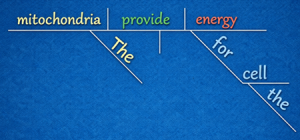 Making abstract rules visible: Clark once compared diagrams to maps or geometry. Today, students can use AI to map their own sentences.
In a ninth-grade science class, a student enters the sentence “The mitochondria provide energy for the cell” into an AI tool. The diagram shows subject, verb, and object clearly. The teacher then uses this visual to emphasize how precision in sentence structure supports scientific clarity.
- Slowing down language: Diagrams once helped learners pause and study structure. AI can extend this by letting students test and revise sentences.
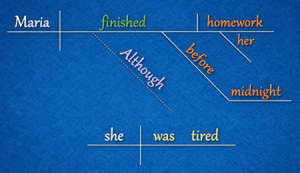
A tenth grader experimenting with the sentence “Although she was tired, Maria finished her homework before midnight” removes the opening clause. The AI redraws the diagram instantly, showing how the structure simplifies. The student sees how subordination creates complexity in academic writing.
- Supporting multilingual learners: Just as diagrams once anchored abstract grammar, AI can extend this benefit with side-by-side comparisons.
An eighth-grade newcomer compares “I am eating an apple” with “Estoy comiendo una manzana.” The diagrams reveal how English separates subject and verb while Spanish often combines them. This sparks a meaningful discussion about how languages handle pronouns differently.
- Enhancing writing conferences: AI diagrams can enrich one-on-one teacher conferences.
A teacher sits with a student who is revising a history essay. Together, they paste a long sentence into an AI diagrammer. The tool reveals that the sentence is overloaded with stacked modifiers. Seeing the diagram, the student recognizes why the sentence feels confusing and begins breaking it into shorter, clearer sentences. The focus shifts from error correction to exploring how grammar shapes meaning.
These examples show how AI can translate the historical benefits of diagramming: clarity, visualization, structure, and reflection, into modern, adaptive classroom practices. What was once static and uniform can now be immediate, contextual, and personalized.
A Balanced Way Forward
The debate about diagramming has often stalled between nostalgia and dismissal. AI allows educators to move beyond this divide. It is not about bringing Reed–Kellogg diagrams back into classrooms, nor about discarding grammar altogether. It is about using modern tools to give some students a way of seeing language that makes sense to them, particularly those who are navigating the challenges of learning English.
For me, the memory of Mr. McNally’s chalkboard diagrams is not about the precise mechanics of the lines but about the clarity they gave me as an English learner in middle school. I may have forgotten how to draw them, but I have not forgotten the feeling of understanding. I am not making a sweeping recommendation, but a common ground alternative. Perhaps some students, like myself, can benefit from seeing grammar made visible in this way.
References
Florey, K. B. (2012, March 26). A picture of language. The New York Times. https://archive.nytimes.com/opinionator.blogs.nytimes.com/2012/03/26/a-picture-of-language/index.html
Graham, S., & Perin, D. (2007). Writing next: Effective strategies to improve writing of adolescents in middle and high schools. Alliance for Excellent Education.
Hillocks, G. (1986). Research on written composition: New directions for teaching. National Conference on Research in English.
Myhill, D., Jones, S., Watson, A., & Lines, H. (2012). Re-thinking grammar: The impact of embedded grammar teaching on students’ writing and students’ metalinguistic understanding. Research Papers in Education, 27(2), 139–166. https://doi.org/10.1080/02671522.2011.637640
Thomas, P. L. (2014, August 24). Diagramming sentences and the art of misguided nostalgia. Radical Scholarship. https://radicalscholarship.com/2014/08/24/diagramming-sentences-and-the-art-of-misguided-nostalgia/
Dr. Andy Szeto is a New York City–based educational leader, writer, and professor focused on instructional leadership, district systems, multilingual learner advocacy, and responsible, practical uses of AI in education. He is the author of Leading Before the Title: Growing Leadership Multiple Tracks and is writing a new book about his journey as an English learner (due late 2026); learn more at drandyszeto.com.