Using a True Crime Book as a Bridge Towards L2 Literacy
By Elizabeth Farro
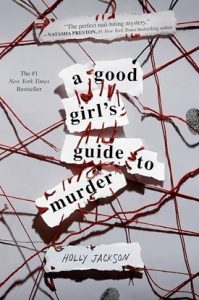 In my high school ELL Advanced class, I like to provide an environment that is both challenging and engaging – my level 3-4 MLs are exposed to more “literary” texts, and are expected to analyze them for the deeper meaning, not merely basic comprehension. One of the most successful ways I have both challenged my students, and maintained their interest, is through the genre of true crime. Specifically, we read A Good Girl’s Guide to Murder, a young adult mystery novel by Holly Jackson.
At 387 pages, this novel seems intimidating and daunting when first placed in students’ hands; however, once they have been given the “game plan” on how we will be conducting this unit of study, they are actually eager to begin!
I break this unit down in the following way:
- Students will listen to the audiobook version of the novel, as if it were a true-crime podcast.
- “Episodes” are a combination of 3-4 chapters (there are fifty chapters in total, which means that there are 14 episodes).
- Students will listen to the audio (along with the text)
- They will then answer brief questions, as well as complete a “case study” on the crime that Pippa (the main character) is trying to solve.
The students have two primary responsibilities as we listen and read: First, they must maintain their case file; second, they must answer questions based on the specific “episode” being read.
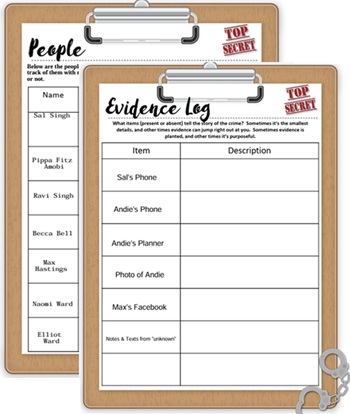 The components of the case file include:
- Victim KWL
- “Episode” summaries
- Key people involved in the case
- Evidence log
- Key locations
- Timeline of events
- The student’s personal theory (I have them complete this page at the end of Episode 11, which is right before all is revealed to the reader)
This case file serves as the means in which the students engage with the “deeper meaning” of the text. They have to look for clues in the story, remember key concepts, and put aspects together in a single narrative.
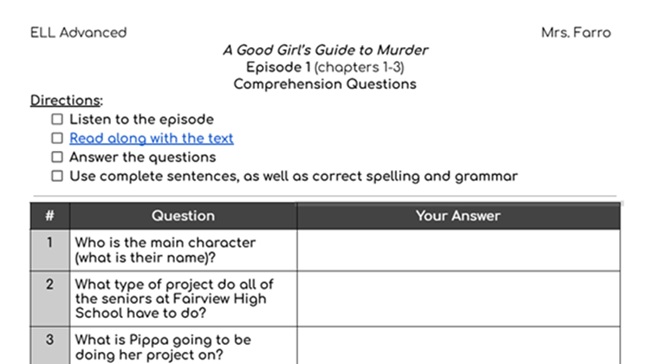
As a means of checking for general understanding, and to provide scaffolding for students that may struggle, students complete comprehension questions for each episode of the text:
The reading of this novel culminates in their final project: making a “murder board” – something that the main character does in the novel as well! I use Prezi to outline the requirements of the Murder Board Project, and also provide a detailed rubric for students to look at as they complete their project. Students are allowed to use Prezi, Google Slides, Canva, or Adobe Express for this project, and I encourage them to use a platform that they are most comfortable with.
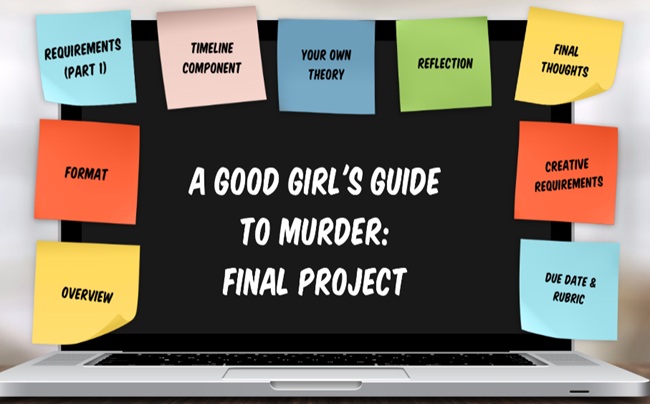
Overall, students enjoy this unit of study, and love trying to put all of the clues together and be the first one to solve the case. Due to the fact that this novel is more “entertaining” than that of a traditional novel taught in the high school ELA classroom, my students engage in higher-order thinking skills such as predicting, inferencing, and analyzing in a more seamless and effortless way.
Though it is a YA text, there are some more “adult” themes present, such as coarse language, underage drug and alcohol use, romantic relationships (no graphic scenes or descriptions), and the mention of sexual assault. Due to this, I highly recommend that this novel be used only in the high school classroom, and students be given trigger warnings ahead of time. I have yet to have a student express discomfort with these elements, or the novel overall, but as a precaution, I have the page numbers of these potentially disturbing things marked, and can skip them without compromising the rest of the narrative.
As part of their final project, I have the students write an honest reflection of the novel, and I give them the option of sharing it with the rest of the class during their presentations. Students always have positive things to say about this text, and it even encourages them to go out on their own and read the next two books in the series!
I am happy to share more information regarding this novel unit, and provide other means of engaging with multi-level MLs in the true crime genre. For resources, questions, or merely to say hello, please reach out to me at esl-secondary-rep@njtesol-njbe.org. I am passionate about creating novel-based units of study in the ML classroom, and love chatting and connecting with other educators!
Liz Farro is an educator at Ocean Schools, and the NJTESOL/NJBE ESL Secondary SIG Rep.