
• Home
    • Voices Weekly and Annual Journal
  • Membership
  • Spring Conference
    • Keynote Speakers
  • Scholarships
    • Scholarship Donations
  • Chapters
  • Links & Resources
    • 2026 Voices Journal
    • 2026 Spring Weekly Voices
    • Parent Resources
    • Advocacy
    • Seal of Biliteracy
    • Online Teaching Resources
  • Executive Board
  • About
    • Other Conferences
    • Hotlist Information

Contact Us by Email

webmaster@njtesol-njbe.org
NJTESOL/NJBENJTESOL/NJBE
  • Home
    • Voices Weekly and Annual Journal
  • Membership
  • Spring Conference
    • Keynote Speakers
  • Scholarships
    • Scholarship Donations
  • Chapters
  • Links & Resources
    • 2026 Voices Journal
    • 2026 Spring Weekly Voices
    • Parent Resources
    • Advocacy
    • Seal of Biliteracy
    • Online Teaching Resources
  • Executive Board
  • About
    • Other Conferences
    • Hotlist Information

Schools Turn to AI Translation Tools to Support English Learners


“But experts say the technology is not a replacement for dedicated services that help children acquire English skills for the long term.”

By Lauren Coffey

Coffey explores the benefits and drawbacks of using AI technology for translation. The first scenario presented is a first grade newcomer who is able to discuss a math problem with a classmate through a translation device. The second is a father, who only speaks Spanish, coming to register his child for school using special eye glasses to communicate with the secretary who only speaks English.

Devices with apps such as Pocketalk and Pear Deck help break language barriers and enable students to benefit from the use of their native language. They enable newcomer MLs to understand the important details of a lesson and participate in class.

However, there are serious concerns about over reliance on these devices. Educators agree that these tools cannot replace English language services. There are other means that teachers have been and should use to support MLs in content classes as they are learning the language.

The article also points out some of the problems with these AI systems. One is inaccuracy: the translation doesn’t make sense. Another is that AI is inadequately trained on children’s voices. It can also have issues with the accents of children whose English is unclear because of an accent from their native language. Besides this, it lacks an understanding of other cultures. It can get in the way of interaction between students and between students and teachers. Added to these concerns, there are few if any guidelines for the use of this technology. And if teachers rely on it too much, students may not be prepared to progress in their education.

While this technology has its benefits, its use needs to be limited.

Here are the details.

Announcements

Website & Email

Our website, njtesol-njbe.org and Voices, voices.njtesol-njbe.org were moved to a new host last week. In the process, our email @njtesol-njbe.org was down between June 9 and 11.
If you sent any of us a message during that time, please resend it.
Because of issues with our former host, the 2026 Journal and Weekly Voices are currently on njtesol-njbe.org under Links and Resources. They will be moved back to Voices during the summer.

There is no Advocacy Meeting this Thursday, June 18th. Our next meeting will be July 9th. Complete this Google form if you would like to receive notifications about the Advocacy Committee.

Kathleen Fernandez
Executive Director, NJTESOL/NJBE
executive-director@njtesol-njbe.org

Dear Coaches

If you’d like to submit an advice inquiry to the ESL and Bilingual Coaches you may fill out the “Dear Coaches Anonymous Advice Form”.
You can view previous “Dear Coaches” responses here.

CABR Summer Book Study & Meetings

If you were on our email list last year and want to continue to be a part of the CABR Committee in 2026-2027 or join the summer book study, please complete the Google Form.

Our last CABR meeting of the year, on Wednesday, 17 June, from 7 pm-8:30 pm, will be a conversation about Juneteenth. I invite you to read through the blog series hosted by the National Museum of African American History and Culture, including Frederick Douglass’, “What to the Slave is the Fourth of July?” to ground our conversation in actions that we can take as educators and as a committee to extend beyond symbolic recognition and a day off.

Our official Book Study Kickoff will be on June 23rd, and we have 2 items on the agenda:

Summer Book Study Overview and Intro to author, Gholdy Muhammad via some YouTube talks and interviews, and we’ll begin to discuss the Introduction and first 2 chapters.
Summer Book Study Facilitation Sign Up: You will have the opportunity to sign up for chapters that you would like to facilitate, if you choose. Facilitation requires reading the chapter and preparing a few discussion questions/prompts to pose to the group.

Summer Book Study Flow…
For 6/23: Read the Introduction and Part I (Chapters 1 & 2)
For 7/7: Read Part 2 (Chapters 3 & 4)
For 7/28: Read Part 2 (Chapters 5 & 6)
For 8/18: Read Part 3 (Chapters 7 & 8)

Save the dates for CABR meetings in the 26-27 School Year!
We will be meeting at 7:00 on the 2nd Thursday of every month
Sept 10, Oct 8, Nov 12, Dec 10, Jan 14, Feb 11, Mar 11, Apr 8, May 13, Jun 10

Sincerely,
kiina dordoni
NJTESOL/NJBE Executive Board Member
Countering AntiBlack Racism Committee Chair

What AI earbuds can’t replace: The value of learning another language

By Gabriel Guillen and Thor Sawin

Guillen and Sawin argue that while AI can effectively help tourists and others communicate in basic situations, language learning will not be phased out. In fact, although students are taking fewer language classes and school or college, the use of language learning apps has increased significantly.

The method of language teaching in the past, using translation and grammar, was ineffective. Now, the authors claim that “the gold standard of language learning is the ability to follow and contribute to a live group conversation.”

There are situations that require deeper personal connections, such as meeting new people on the job or giving a presentation to speakers of another language. The ability to communicate in that language builds empathy and trust. This is lacking when AI is used. In fact, incorrect translations by AI can also cause misunderstandings.

Apart from the cognitive benefits of speaking more than one language, “The very attributes companies seek in the AI age – resilience, lifelong learning, analytical and creative thinking, active listening – are all cultivated through language learning.”

Guillen and Sawin theorize that fewer students are taking language classes in school because they think learning another language is irrelevant to their lives. To overcome this issue, the authors suggest integrating language into other subjects, having virtual exchanges, or using project based learning.

To make this possible for teachers, generative AI can help with basic tasks, correcting mistakes, and learning vocabulary so that in the classroom, students can practice having real conversations in class.

You can find more information and links in the article.

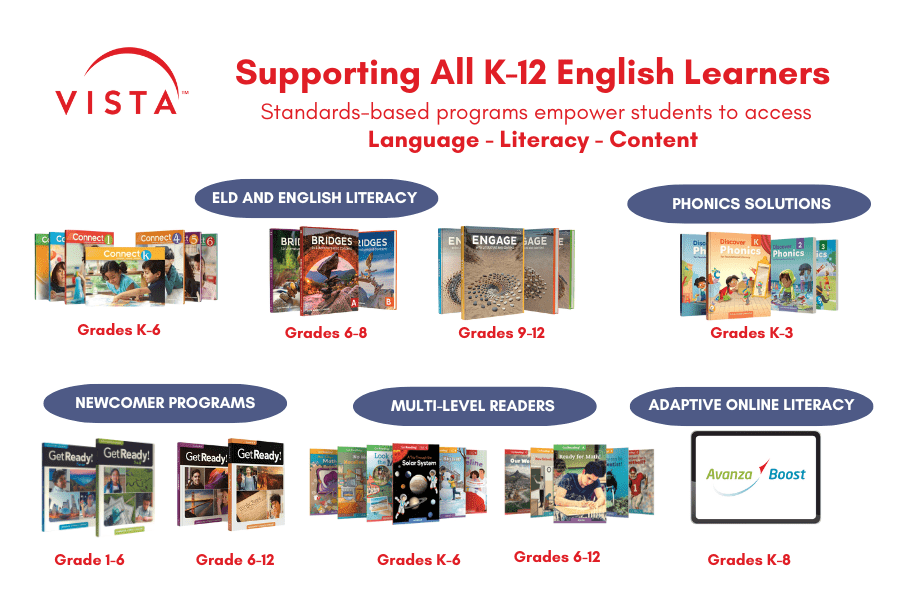
Vista Higher Learning ad

2026 Spring Conference Platinum Sponsor

June 9, 2026

ESL Summit at Bergen Community College

Articles

Instruction as Advocacy– Amber Ingram

Building a Professional Learning Network (PLN) on Social Media: What Worked for Me!– Cecilia Vila Chave

Meet the 2026 Spring Conference Invited Speakers

10 Activities to Improve Your English Vocabulary -Emile Dodds
and
Uncovering Language Learning Strategies for University Students in STEM -Tokyo University of Science

Wordless but not silent: Unlocking the power of wordless picture books -Jennifer D. Honaker, Ryan T. Miller
and
Virtual art meets language learning: A tech-enhanced ESL experience
-Nesreen El-Baz, ESL Educator

The Courage to Learn -Douglas Fisher, Nancy Frey, and James Marshall
and
When Have You Ever Failed at Something? What Happened as a Result? -Katherine Schulten

Adapting Gradual Release of Responsibility for English Language Learners -Tan Huynh and Beth Skelton
and
Using PBL to Support Young English Learners -Cecilia Cabrera Martirena

Language of Identity, Language of Access -Michelle Benegas and Natalia Benjamin
and
Classroom Activities for Building Critical Multilingual Awareness -Naashia Mohamed

Using a True Crime Book as a Bridge Towards L2 Literacy -Elizabeth Farro

Cultivating Team Dynamics that Strengthen ML Instruction -Corinne Galasso

Message from the President
and
Message from the Vice President

All Learners are Language Learners: Planting the Seed of Language Development in ALL Spaces -Cecilia Vila Chave

ESL Summit at Bergen Community College -Leah Carmona

Schools Turn to AI Translation Tools to Support English Learners -Lauren Coffey
and
What AI earbuds can’t replace: The value of learning another language -Gabriel Guillen and Thor Sawin

Contact Us

Send an e-mail to: webmaster@njtesol-njbe.org

Send Message

Home
About Us
Executive Board Nominations
Spring Conference
Other Conferences
Seal of Biliteracy
Advocacy
Chapter News
Membership Application
Discussion List Information
Awards & Scholarships
Scholarship Donation
Helpful Links
Online Teaching Resources
Voices Newsletter
Executive Board
Privacy Policy
NJTESOL-NJBE By-Laws Approved 2-7-2020
Contact Us

For Your Information

Transitional Changes to State Assessments and Graduation Requirements

Position Statement on Language Rights

Testimony to NJDOE about changes to the Bilingual Code

Position Statement on Protecting the Rights of English Language Learners

NJDOE PARCC Testing Accommodations for English Learners

Resource: FABRIC – A Learning Paradigm for ELLs

Important Dates

Spring Conference 2026

May 19, 20, & 21, 2026
(Tuesday, Wednesday, & Thursday)